

What is food insecurity and how do we help stop it?
“Before White Pony Express, my family ate Top Ramen noodles three times a day for the last week of every month. Now we have really good food all month long and a variety we could not have imagined!”
The United States Food and Drug Administration (USDA) defines food insecurity as “the limited or uncertain availability of nutritionally adequate and safe foods, or limited or uncertain ability to acquire acceptable foods in socially acceptable ways.” Before the COVID-19 pandemic, food insecurity afflicted 10.5% of American households. Its pervasiveness has only grown since, more than doubling to an estimated 23% of households. For households with children, this is an even greater issue, with about 27.5% to 29.5% facing food insecurity as of June 2020. Food insecurity is also far from a distinctly American epidemic.
“The problem is hardly unique to the U.S. According to the United Nations World Food Program, the global pandemic has the chance to double the number of people experiencing acute food insecurity, from 135 million in 2019 to 265 million in 2020.” [NPR -“Food Insecurity in The U.S. By The Numbers”]
California is a prime example of food insecurity among U.S. states. Approximately 40% of low-income adult Californians are not able to buy enough food, according to the state government. Additionally, 1 in 4 children experience food insufficiency. Data from the California Association of Food Banks indicate that around eight million Californians are uncertain about when and where they will next obtain their next meal—something so fundamentally essential to their survival.
Furthermore, food insecurity is as intersectional as it is an individual lived experience. Black households experience food insecurity at nearly twice the rate as white households, and the same can be said for Hispanic Americans.
It’s important to note, however, that food insecurity within the U.S. is not a product of limited supply relative to demand. In reality, 30-40% of all food produced is wasted each year, and just 30% of that food waste is estimated to be enough to cover the total dietary needs of every hungry person in the country.
Establishing community-based food rescue and distribution channels is vital to ensuring abundance meets need wherever it resides. Ultimately, the crux of the problem is distribution, not supply.
Educating ourselves about these very real issues and the very real people whom they impact is the first step in stopping hunger.
The true price: The cost to end hunger
Hunger and food insecurity have a number of root causes. According to a report conducted by the Committee on World Food Security (CFS) in 2014, these can be boiled down to governance, economic and production issues, demographic and social issues, and climate/environment.
Neighbors helping neighbors:
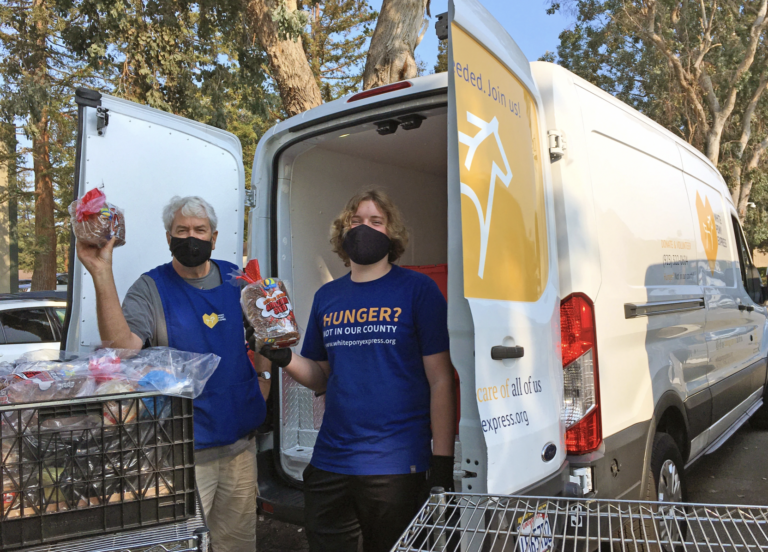
Ending hunger in the community
All positive change begins locally. White Pony Express serves Contra Costa County in California, which in 2018 had a food insecurity rate of 11.1%. This translates to about 128,000 food insecure people in the county—a data point that has embarked on a treacherous journey upwards to in the past eighteen months. Now facing a food insecurity rate of 21.2%, Contra Costa County houses more than 244,000 residents suffering from hunger.
To take individual action, look into community mobilization and volunteer opportunities if you are passionate about facilitating an end to food insecurity. If you have the time, your skills are needed.

In conclusion…
Progress unfurls outwards from the epicenter of individual care and action. Food insecurity is a broad-sweeping issue experienced by hundreds of millions of people worldwide, but there are also millions of hands ready to help, and millions of ears ready to listen. We’ve witnessed this firsthand at White Pony Express, and we’re excited to keep sharing our story with you!
Read about the experience of one of our recipients.
“I volunteer at WPE to help the community and affect and improve people’s lives. As a community, we work to help one another. We all look out for each other and work together.”
—Shaya, High School Student and Food Rescue Volunteer